
Edmond City Directory Holdings
Edmond's historical directory trail is strongest in local and state research rooms, not in a complete public web database. The Edmond History Museum Research Library & Genealogical Center confirms that it holds local directory volumes, Edmond Sun microfilm, school yearbooks, family histories, cemetery records, and vertical files. The Oklahoma Historical Society bibliography verifies two distinct Edmond volumes. A directory search should begin with the nearest known year, then move out to the Museum and OHS when a gap appears. A directory is a dated snapshot, so use it as a lead rather than proof of a person's full residence period.
| Edmond collection | Years located | Custodian | How to use it |
|---|---|---|---|
| Edmond City Directory, John J. Gossett | Spring 1958 | Oklahoma Historical Society Research Center | Inspect the physical volume and its key |
| Edmond, Oklahoma City Directory, Johnson Publishing Co. | 1963 | Oklahoma Historical Society Research Center | Physical-volume verification |
| Edmond city directories | Additional years, not published online | Edmond History Museum | Onsite research and appointment help |
| Edmond Sun microfilm | Newspaper began 1889 | Museum and OHS channels | Notices, addresses, and local context |
| Sanborn maps | 1894, 1898, 1901, 1903, 1908, 1914 | Library of Congress | Street, lot, and building context |
The full Museum directory run, reverse-directory titles, and a digitized sample page were not published in the sources reviewed. Ask staff to identify the available years and whether an address section exists before treating a missing name as a negative result.
Edmond Historical Directory Research Room
The Museum's research library at 431 S. Boulevard is the practical local starting point for historical directory volumes. It is open Monday through Friday from 10 a.m. to 5 p.m. and Saturday from 1 p.m. to 4 p.m.; it is closed Sunday. The collection has more than 5,000 books and periodicals, along with local yearbooks and the Edmond Sun on microfilm. Edmond Genealogical Society volunteers assist by appointment through the Museum at (405) 340-0078. Bring a precise name, probable date range, and both current and old street spellings.
The Museum research-library page shows the local genealogy collection and its access details.
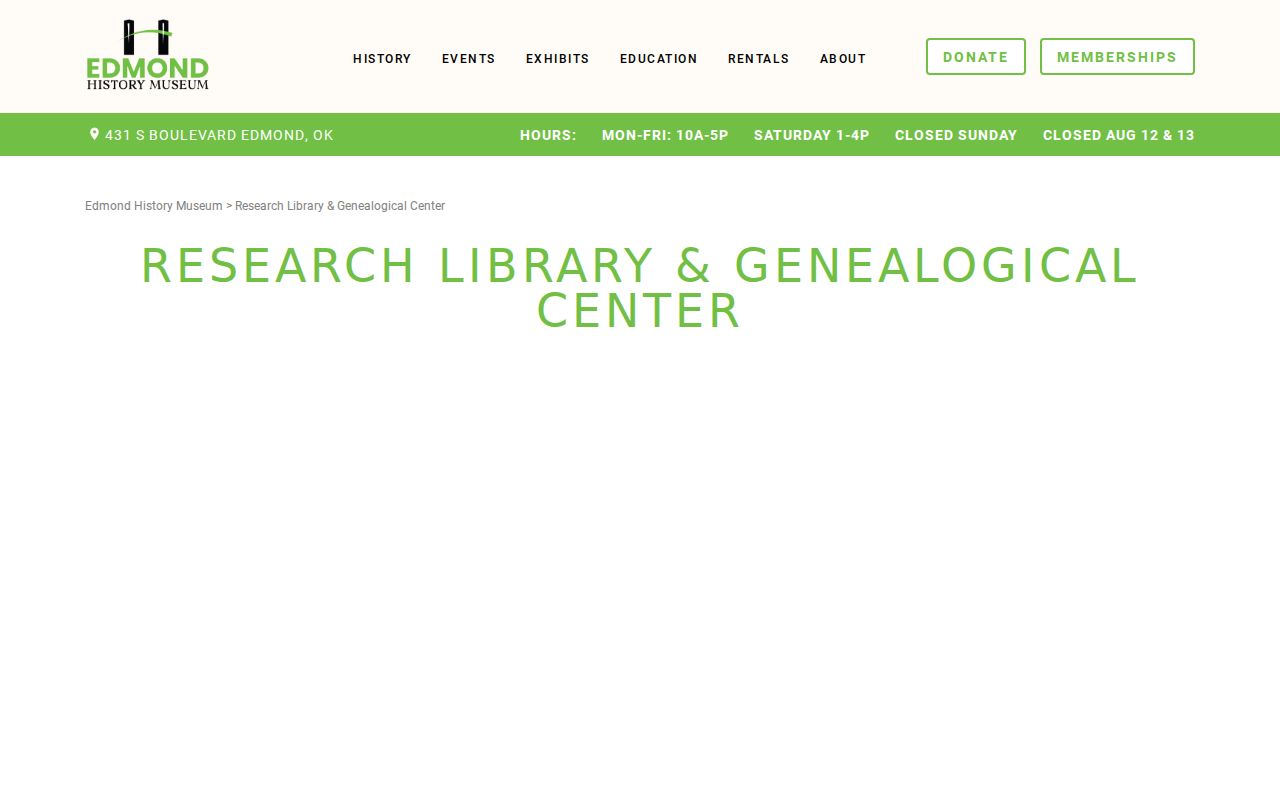
Its directory shelf is best used alongside the Edmond Sun microfilm, yearbooks, cemetery records, and vertical files, because each source captures a different moment in an Edmond household's history.
Edmond Directory Volumes by Date
Two citations give solid anchors for a historical Edmond directory search: John J. Gossett's Edmond City Directory from Spring 1958 and Johnson Publishing Co.'s Edmond, Oklahoma City Directory from 1963. The Oklahoma Historical Society used both in a historic-property survey, confirming that they are Edmond volumes rather than a generic metropolitan listing. Their exact entry layouts remain an onsite question, so do not assume an owner symbol, a street section, or a telephone arrangement until the volume itself is open.
| 1889 | Edmond Sun begins, providing an early local name and notice trail. |
|---|---|
| 1894 to 1914 | Six known Edmond Sanborn editions record the built setting and street layout. |
| Spring 1958 | Gossett's verified Edmond City Directory appears in the OHS bibliography. |
| 1963 | Johnson Publishing Co.'s verified Edmond directory follows. |
| Later years | The Museum confirms holdings, but the complete year list was not available online. |
That short, verified timeline matters. It prevents false claims that directories ran continuously or that a missing year proves a household moved away.
Read an Edmond Directory Entry
Directory publishers commonly arranged people alphabetically and sometimes added street, telephone, or classified sections. A complete entry may offer a surname, given name or initials, address, spouse notation, telephone number, and a historical occupation or place-of-work clue. The 1958 and 1963 Edmond page images were not publicly available, so the marks below are an inspection checklist, not a claim about every Edmond volume. Photograph or transcribe the title page and abbreviation key before interpreting a symbol.
| Name form | Preserve initials, spelling variants, and any spouse or widow notation exactly. |
|---|---|
| Street address | Copy the number, direction, suffix, apartment marker, and addition name if shown. |
| Household clue | Note a spouse, telephone, or other relationship information without turning it into a current claim. |
| Historical identity clue | Record any historical occupation or organization only as an aid to distinguish same-name people. |
| Volume key | Use the publisher's own abbreviations and symbols, not assumptions from another city. |
- Criss-cross directory
- An address-ordered section that may list entries by street and number. The Museum confirms directory holdings, but its exact reverse-run inventory needs onsite confirmation.
- Householder index
- An index centered on the principal household name rather than every person associated with an address.
- Abbreviation key
- The publisher's explanation of short marks and labels, usually near the front of a volume; it should be copied before reading entries.
Edmond Directories and Newspaper Evidence
A dated directory can suggest when to search a newspaper, but it cannot explain every change. The Edmond Sun began in 1889, and its microfilm is held locally. OHS also provides searchable newspaper resources, including the Gateway to Oklahoma History and onsite microfilm. For a later endpoint, the OHS Oklahoman obituary index covers 1972 through 2014 and contains more than 275,000 names. An obituary or funeral-program hit can help distinguish a move from a death or a simple omission.
The OHS obituary index offers first-name, last-name, and year filters for that later corroborating search.
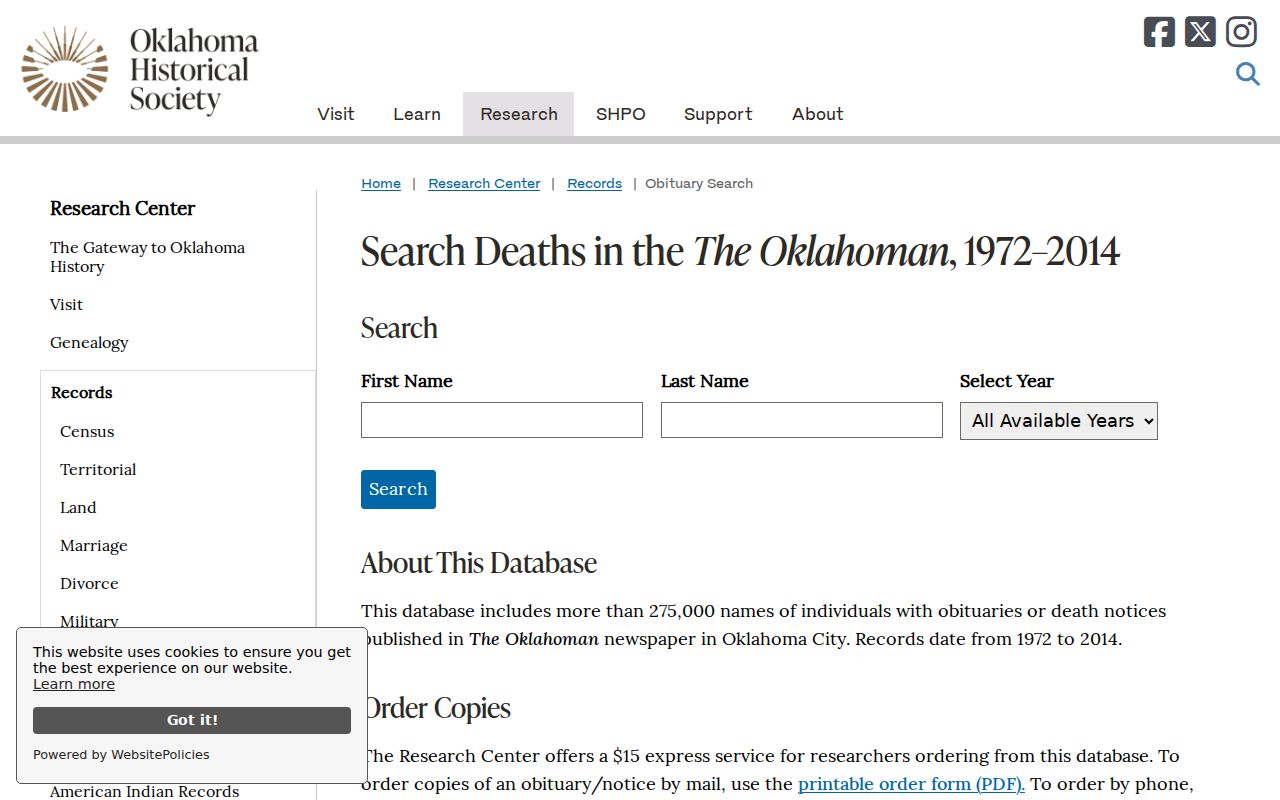
The index is a starting point, not an address register. Request or inspect the underlying item before connecting an obituary to the person in a city directory.
Trace Edmond Households Across Directory Years
Follow a household forward and backward with records that each answer a different question. Start with a known Edmond directory year, keep the spelling and address as printed, then compare the next available directory rather than inventing a yearly run. Federal population schedules are generally released on the 72-year cycle, and the 1950 census is public. OHS and UCO hold additional census and index resources. A same-name result is only a lead until address, relatives, deed, probate, or vital evidence links it.
- Locate the person in the closest verified Edmond directory and copy the entire entry and its source year.
- Check the earlier and later available volume, recording every address change, spelling change, and household clue.
- Use the city street index, addition name, and Sanborn sheet when an old street reference no longer matches a modern address.
- Pair the directory snapshot with the nearest released census, then compare names and household relationships rather than relying on surname alone.
- Finish with an obituary, cemetery, probate, or newspaper search if the person disappears from the available directories.
For a modern parcel or a deed chain, use the Edmond previous residents workflow instead of treating a historical volume as title proof.
Edmond Directory Streets Before Today
Older Edmond addresses often need a street-history check. Broad Street became Broadway by 1890, the 1886 survey line became 15th Street, and a section line became 2nd Street. The City Street Names List also pairs street names with additions and map codes. When a directory gives an addition name or an abbreviated street, preserve it. That detail can link a household to a plat, a Sanborn sheet, or an Oklahoma County land record even when the house number changed.
The Library of Congress 1894 Edmond Sanborn map is the earliest digitized edition found, with related 1898, 1901, 1903, 1908, and 1914 maps listed beside it. Sanborn sheets show lots and building footprints, not a complete list of people. Note: A street or building match strengthens a directory lead but does not identify every person who lived there.
Edmond Directory Names in OHS Indexes
OHS historical indexes help test a directory household without turning a name match into a conclusion. Its Oklahoma County marriage index covers 1889 through 1951 across 175 county volumes and can include bride and groom names, age, ceremony date, and sometimes birthplace, address, or parental-permission details. The county index includes people from well beyond Edmond, so it requires a second local connection such as a directory address, newspaper notice, or cemetery record.
The OHS Oklahoma County marriage index shows the searchable historical-record format.
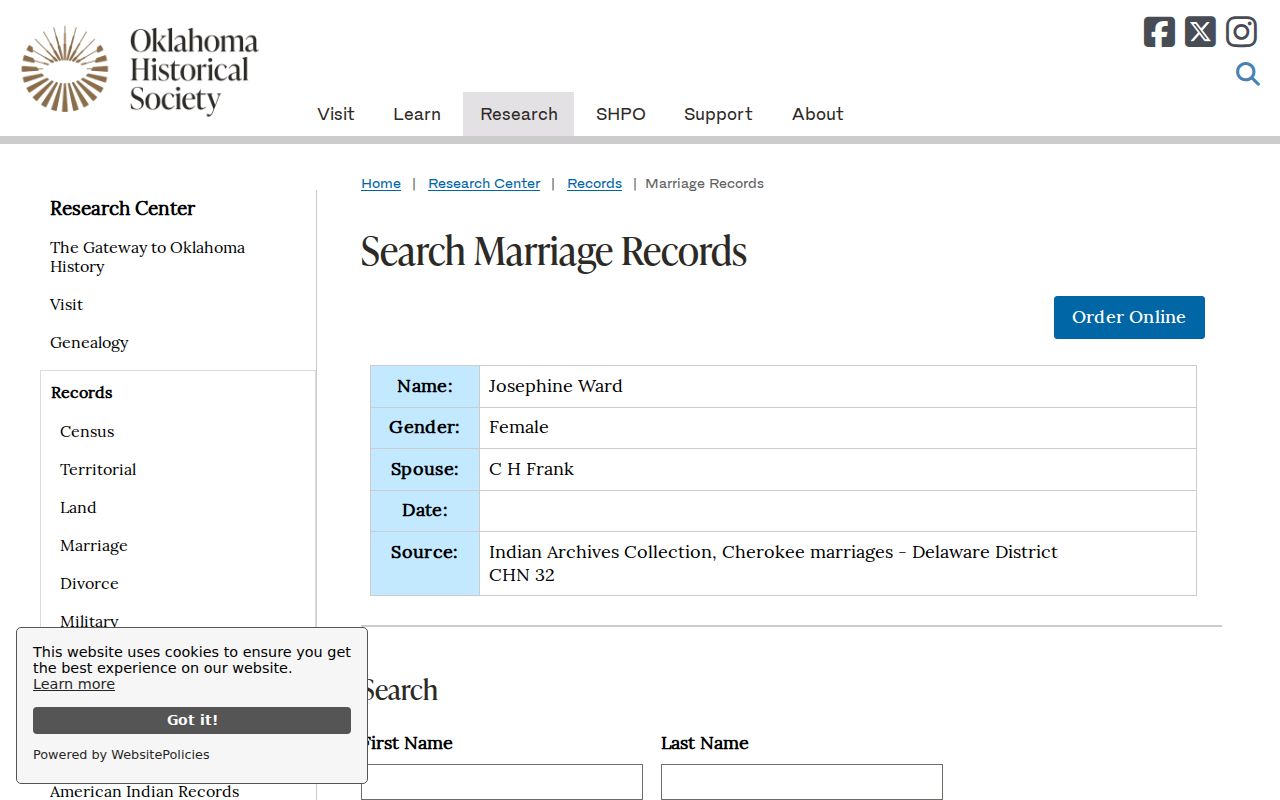
Marriage-index fields can narrow two people with the same name, but the original record, a directory volume, or another dated source should confirm the Edmond connection.
Edmond Directory Companion Shelves
When an Edmond volume produces only an initial or a short address, the local-history collections offer several ways to test the lead. The Museum holds Edmond High School and University of Central Oklahoma yearbooks, local family histories, Gracelawn cemetery records, and vertical files on local people and events. UCO Archives & Special Collections is identified in Oklahoma genealogy listings as a holder of Oklahoma census and index material, Sanborn maps, tract-book indexes, and a computerized Edmond newspaper index reaching back to 1889. Contact the archivist before travel because current detailed collection access was not confirmed in the reviewed sources.
At the state level, the Oklahoma Historical Society Research Center has more than 10,000 vertical files, 5,700 manuscript collections, nearly one million pages, newspapers, maps, photographs, and indexed historical material. A vertical file is a staff-assembled folder of clippings, notes, and related items. It can offer context for a directory household, but it is not a substitute for a dated directory entry or an official record.
Edmond Directory Names Before Print
For the period before the verified printed volumes, Edmond history begins with railroad and land records rather than a long city-directory run. The site was called Mile Marker 103 in the 1886 survey, became an official Santa Fe station in 1887, and grew rapidly after the April 22, 1889 Land Run. OHS's Oklahoma County 1889 final-land-certificate index can supply a name, town or location, legal land description, and notes. That makes it a useful bridge from a historic person to a tract, plat, or later address.
The index has an important limit: it lists people who received final certificates, not every entrant, occupant, or Edmond resident. Pair a land-certificate result with deeds, the Edmond Sun, census records, probate, or cemetery evidence. Note: A land-run name can establish a strong research lead, but it does not prove that a household occupied a later numbered address.